Featured

The New Style of Animation

Animation has been around for many years, with the period known as the ‘classical’ period from 1937-89, very few films were made in this era but Disney were the lead dominators of the area; with Snow White and the Seven Dwarfs in 1937 being the first of the Disney Princess film which again started a stream of princess films that continue today, with the likes of 2013’s Frozen which made $1.27 Billion in the box office alone. During this current time period, we are now experiencing the post-classical or contemporary period and animation has grown and become a huge phenomenon with the major companies such as Disney, Dreamworks and Pixar, creating films that have a huge range of diversity not only in their style but also in the genre and themes, a growth in the production of the films and an increase in the popularity and importance of animation in film. One of the biggest examples of this was Avatar (James Cameron, 2009) and more recently,  Alita: Battle Angel (James Cameron, 2019) both of which incorporated live action and animation elements to create blockbuster films; animation has become a very popular and sure way of making money in Hollywood. 

In recent years, Disney has found that recreating their older animation films into live action films is a huge success; one of their most popular animated films, The Lion King from 1994 was recreated in 2019 with an array of all black actors and celebrities such as Beyonce and Donald Glover (Childish Gambino) whom were playing the African lions and animals; this was a major selling point for Disney as it was showing the audience that they are aware of the diversity problems in Hollywood and are making changes. Disney have also remade classics such as Dumbo, The Jungle Book and Lady and the Tramp. Again, this is a clear example that animation is a huge selling point in Hollywood and Disney are taking advantage of this. 

However, with the new era of animation brings about new themes to include and sell within the animation sector of Hollywood. With indie style directors such as Tim Burton who has created and produced some very popular animation films like The Nightmare Before Christmas, Corpse Bride, James and the Giant Peach. These films have a distinct animation style that can be described as gothic and a homage to the German Expressionism of the 1920s, this connection comes from the oblique angles, exaggerated makeup (or in the case of animation, the facial features) and distorted settings. The German Expressionism films were usually in the genre of horror and sci-fi which also lends a hand to what category Burton’s films fall under. Both his animation and live action films share this same distinct style and have been a favourite amongst those who identify within Gothic culture. 

Although his animation films are aimed towards children, they have a sense of adult themes mixed within, his style is described as,”dark, demented, and nightmarish, but they also have a strange innocence and element of childlike wonder” (Renee, 2016). This is apparent in his dark, children’s films such as a remake of his 1980s film Frankenweenie, The Nightmare Before Christmas and Alice in Wonderland. Although these films are catered for younger audiences, the style is dark in tone and focuses on more adult themes. Frankenweenie is loosely based on the story of Frankenstein by Mary Shelley but focuses on a young boy wanting to bring his dog back to life after the dog is hit by a car; this focus of death and the afterlife, when spoken about this would not usually be a typical theme of a Disney’s children film, but Burton makes it work. 

Moreover, Burton’s most known animations are his stop motion films such as Corpse Bride and The Nightmare Before Christmas. These films again have adult themes and are explicit in their origins of it. Burton’s stop motion style has strong influences from the Latin America Day of the Dead, Burton is said to have done this by including, “reanimated skulls and skeletons known as calaveras, and calacas, skulls and skull masks worn during ceremonies.” (Romano, 2019). This can be seen in the character styles of both Emily from the Corpse Bride, Sally and Jack Skellington from The Nightmare Before Christmas. Their faces are over exaggerated skulls. This theme of the Day of the Dead is most prominent in The Corpse Bride, when the character reaches the underworld he is met with colourful faces of skeletons wearing hats and performing musical numbers which is explicit in it’s Dead of the Dead origins and influence. Additionally, Burton takes many influences from other holidays such as Christmas and Halloween, which is seen in one of his most popular stop motion animation films The Nightmare Before Christmas. 
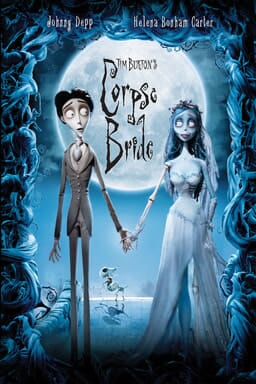
Image result for corpse bride
The Corpse Bride (Tim Burton, 2005)

The Nightmare Before Christmas was and stays popular from it’s release in 1993 to the present day, this animation is easily one of Burton, and Disney’s most recognised amongst many audiences and becomes particularly popular during Halloween and Christmas time. The film is unequivocal and dripping in Burton-esque style; with connotations and examples of the German Expressionism, although it is not shot on a real camera, Burton is still able to replicate the ‘chiaroscuro effect’, by creating atmospheres with geometric shapes, the houses and buildings in ‘Halloweentown’ are spiral or curved and crooked, this effect was used in German Expressionism to highlight the chaos in the world. (Leow, 2016). The film also focuses on children’s fears such as skeletons and monsters under the bed, this is highlighting the dark themes of Burton’s animations but with a twist. 
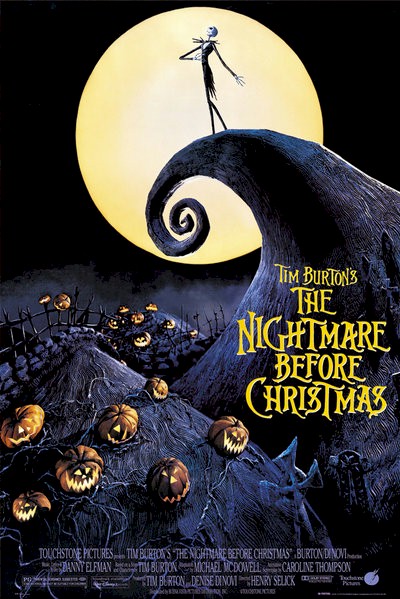
nbcmoviecomm
The Nightmare Before Christmas (Tim Burton, 1993)

To conclude, animation in Hollywood has, and always will be, a very popular and high selling point for directors and companies. Although, with the classical period over, it paves the way for a new type of animation to be brought to life on screen. Tim Burton’s distinct and popular stop motion animation gives light to this and continues to be original and entertaining. 

References

Renee, V. (2016). ‘Burtonesque’: Breaking Down the Gothic Cinematic Style of Tim Burton. [online] No Film School. Available at: https://nofilmschool.com/2016/09/burtonesque-breaking-down-gothic-cinematic-style-tim-burton [Accessed 16 Jan. 2020].

Romano, A. (2019). Tim Burton has built his career around an iconic visual aesthetic. Here’s how it evolved.. [online] Vox. Available at: https://www.vox.com/culture/2019/4/17/18285309/tim-burton-films-visual-style-aesthetic-disney-explained [Accessed 16 Jan. 2020].

Leow, J. (2016). German Expressionism in Tim Burton’s films – J’s. [online] Oss.adm.ntu.edu.sg. Available at: https://oss.adm.ntu.edu.sg/janl0001/german-expressionism-in-tim-burtons-films/ [Accessed 16 Jan. 2020].

Love, Simon and the Rom-Com Genre

Love Actually, When Harry Met Sally and Notting Hill are just a few of the staple romantic comedy films everyone would think automatically of when thinking of this genre of film. But, society has changed a lot since the release of many of this films and romantic comedy does not just apply to the white, cis heteronormative relationship between man and woman anymore there is not a yearning for the man who is more popular than the woman or that gender is a ridgid binary. These types of constructions are the reason there are many people in our contemporary society whom feel they are being misrepresented or under represented by this genre of film.  This issue has brought many debate and argument for new films that represented the contemporary way of living.

The 2018 film book adaption from “Simon vs. the Homo Sapiens Agenda” by Becky Albertalli, Love, Simon (Greg Berlanti, 2018) was one of the best representations of a homosexual relationship in a romantic comedy in the past years. The film appealed to the traditional tropes and outer form of the romantic comedy genre that everyone seems to fall for every time; the high school setting which brings with it the ideas of sex, puberty and growing up in society, friendship and trust and the ‘will they, won’t they?’ theme. However, whilst Love, Simon does bring these traditional ideas and themes for the romantic comedy film, it also has brought light and direct conversation about major contemporary issues that many LGBT+ children and young adults have to face growing up in high schools in modern society and giving an outlet for said children and young adults to project and find themselves in; shown in the main character, Simon, being a young, closeted homosexual man trying to live a life where he can be perceived as ‘normal’ amongst his peers. 

Love, Simon challenges most romantic comedies through having a homosexual man as the lead character where in films like Mean Girls, Clueless and Sex and the City the LGBT+ characters are used mainly for comedic value or the stereotypical ‘gay best friend’ to further the their straight counterparts plot line or love story, Love, Simon aims to push these representations away with not only having his friends all be the straight best friends with comedic value but also, not having a tragic and heart breaking representations of gay men usually shown in cinema; Brokeback Mountain, Call Me By Your Name and Lost and Delirious being an example of this. Love, Simon actually has a happy ending where the two men get together in the end and the film ends with a heartfelt shot of the two kissing, (Opie, 2018.)

Another way Love, Simon challenges stereotypical conventions is through having the love interests not meeting until the very last sequence of the film, most – if not all, romantic comedies are heavily influenced by the main characters having to change themselves to gain attention from their love interest or by society, this is seen in many popular romantic comedies such as Easy A, She’s the Man and To All The Boys I’ve Loved Before being just some of the examples of this. Love, Simon instead has Simon fall in love over email, so he is being his true self and not trying to be someone different to impress society, this also highlights the importance and influence social media has on contemporary coming of age stories. 

Image result for love simon
Love, Simon (Greg Berlanti, 2018)

Although the film is happy and cheerful watch, it also presses on and highlights some real world issues with being a LGBT+ individual in society, which is another reason why Love, Simon is so important for audiences. When the character of Martin threatens to ‘out’ Simon when he finds Simon’s correspondences with his love interest. This is a very personal and traumatic experience for many LGBT+ individuals in society and by having it played out in a Hollywood blockbuster is so important for the representation of what individuals in society fall victim too. Also, there is a scene where the film ask, ‘why is straight the default?’ with several of Simon’s friends coming out to their parents as straight, this is a funny scene which again challenges the idea that someone who is not straight has to come out to their family and force it upon themselves. Another interesting part is when Simon does come out to his friends, they are not angry at him for being gay, but they feel like they were owed an apology for him lying about his sexuality and his friend Leah felt embarrassed because she thought he reciprocated her feelings for him. This scene is important but also very interesting in regard to the typical ‘coming out’ scenes in film,  as Simon’s friends do not care that he is gay, but that he felt he could not tell any of them, when in most films when the LGBT+ character comes out they face predjudice because they are LGBT+.

To conclude, Love, Simon is a very important and influential film for LGBT+ youth and even just the romantic comedy audiences in general, it highlights and challenges many of the stereotypical genre conventions of romantic comedy whilst still being a film of the same genre. This film has helped pave the way for new representations of LGBT+ individuals in film and even Disney are now producing a series based on the film. 

References

Opie, D. (2018). ‘Love, Simon’: Why It’s The Most Important Movie of The Year. [online] Highsnobiety. Available at: https://www.highsnobiety.com/p/love-simon-movie-important/ [Accessed 2 Jan. 2020].

The Final Girls in Slasher Films

When you think of the horror film, there is one typical setup for the slasher film: girl and friends or family, family and friends are killed, girl left to defend herself and finally kills the villain. In horror films, the final girl trope is a popular motif used. It refers to the last girl or woman alive who challenges the killer. This is mainly a popular trope in slasher films such as Scream (1996-2011), You’re Next (2011) and The Texas Chainsaw Massacre (1974).

First of all, the term of the ‘slasher’ film is a subgenre within the horror movie genre, with many saying that some of the first slasher films consist of the 70s classics such as Bay of Blood (1971), The Texas Chainsaw Massacre (1974) and Black Christmas (1974). These films have laid out the back bones of what the audiences of slasher films expect, and it is a perfect way to be sure that people will watch your film, as audiences are more likely to watch something, they are familiar with.

However, this trope has both positive and negative connotations in relation to the feminist beliefs in society, there comes many stereotypical conventions of the ‘final girl’ character which are portrayed in the various popular final girl characters that have spanned across the years from Sally in Texas Chainsaw Massacre to Tree in Happy Death Day; the majority of these characters are known for being either sexually promiscuous or virginal for example, in Halloween, Laurie’s friends whom have been exposed to sexual relations are murdered before she is, her friend Bob is killed by the killer after having sex with his girlfriend- this murder can be seen as a repercussion of him having sex with his girlfriend, the killer then pretends to be Bob and eventually murders his girlfriend too. This portrayal of the sexually active members of society being murdered is a very conservative view, particularly of ever-growing Reaganomics in 80s America. This idea tells the audience that women who are comfortable with their sexuality, engage in sexual activities before marriage or are more liberal inclined are more likely to be punished by society and seen as outcasts.

On the other hand, there is a positive outcome of the final girl trope as it shows how women are standing up for themselves and showing they can also have the courage and strength to be the lead in a traumatic event, where women are usually the damsels in distress. The idea of the ‘final girl’ motif was first coined by Carol. J Clover in her 1992 book “Men, Women and Chainsaws: Gender in the Modern Horror Film”, she argues in her first chapter that in the increase with slasher films with female protagonists the audience have become accustomed to the female becoming more inclined with masculine traits to survive. “She alone looks death in the face, but she alone also finds the strength either to stay the killer long enough to be rescued, or kill him herself,” (Clover, 1992). The final girls eventually battle out the traditional patriarchal society whom have become reliant on the view that women are less able than men but instead the final girl like Clover mentions how the females have now got masculine attributes, such as physical violence, to survive the attack, mostly seen in the 90s slasher films.

This idea is presented in the Scream franchise created by Wes Craven, Scream is different than other slasher films as the characters utilizes the stereotypical conventions of a slasher film as they begin to realise the events happening in their town are reflecting that of a slasher film. Throughout the franchise, it focuses on the character of Sidney who is ultimately a caricature for females in society as she reflects the concerns of female teens with sexuality, virginity, femininity and identity. (Karlyn, 2011) Unlike her other final girl counterparts, Sidney’s sexuality is her strongest suit as she decides herself to have sex with her boyfriend and still is able to kill the killer; whom is her boyfriend. A popular motif and running joke throughout the Scream movies is that the ‘slut always dies first,’ again being a reflection and comment on the older slasher films. Furthermore, the film comments on the idea of masculinity and femininity. Many texts have commented on the only reason many of these final girl characters survive their trauma is due to the killer being a more attuned feminine traits just as the final girl is attuned to their masculine traits. (Clover, 1992).

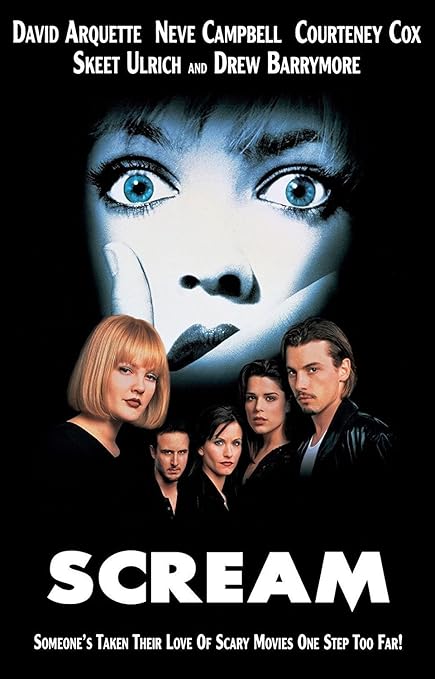
Image result for scream poster
Scream (Wes Craven, 1992)

Unlike many representations of the final girl characters, Sidney is more knowledgeable and able, she does not get caught by the killer and unmasks the killer. The scream franchise is directly putting the female protagonist and female characters in danger and forcing the protagonist into the final girl role. A clear example of this at the beginning of the film, the character of Casey is left at home by herself and waiting for her parents to get home, she is preyed on by the killer because she is alone and vulnerable and ultimately killed. Again, this happens to the protagonist but the outcome is different than that of Casey’s. Sidney’s father leaves her alone in the house and she has a face off with the killer and she survives, Sidney also is the character to get revenge on the killer whom is her boyfriend, stripping away his masculinity. Sidney’s father, along with her boyfriend, are the murder suspects however, Sidney is left to save her father when he is captured by the killer, resulting him into being a damsel in distress character; which is usually reserved for the females in movies. As the female protagonist is left into saving her father, this ties into the idea that men are weaker than females in the modern slasher horror films.

To conclude the final girl trope in horror film is well known and used to exemplify strong female characters and how they overcome their femininity to defeat the killer.

References

Clover, C. (1992). Men, Women and Chainsaws: Gender in the Modern Horror Film. London: British Film Institute.

Karlyn, K. (2011). Unruly Girls, Unrepentant Mothers. Austin: Univ. of Texas Press, pp.99-103.

Design a site like this with WordPress.com
Get started