When you think of the horror film, there is one typical setup for the slasher film: girl and friends or family, family and friends are killed, girl left to defend herself and finally kills the villain. In horror films, the final girl trope is a popular motif used. It refers to the last girl or woman alive who challenges the killer. This is mainly a popular trope in slasher films such as Scream (1996-2011), You’re Next (2011) and The Texas Chainsaw Massacre (1974).
First of all, the term of the ‘slasher’ film is a subgenre within the horror movie genre, with many saying that some of the first slasher films consist of the 70s classics such as Bay of Blood (1971), The Texas Chainsaw Massacre (1974) and Black Christmas (1974). These films have laid out the back bones of what the audiences of slasher films expect, and it is a perfect way to be sure that people will watch your film, as audiences are more likely to watch something, they are familiar with.
However, this trope has both positive and negative connotations in relation to the feminist beliefs in society, there comes many stereotypical conventions of the ‘final girl’ character which are portrayed in the various popular final girl characters that have spanned across the years from Sally in Texas Chainsaw Massacre to Tree in Happy Death Day; the majority of these characters are known for being either sexually promiscuous or virginal for example, in Halloween, Laurie’s friends whom have been exposed to sexual relations are murdered before she is, her friend Bob is killed by the killer after having sex with his girlfriend- this murder can be seen as a repercussion of him having sex with his girlfriend, the killer then pretends to be Bob and eventually murders his girlfriend too. This portrayal of the sexually active members of society being murdered is a very conservative view, particularly of ever-growing Reaganomics in 80s America. This idea tells the audience that women who are comfortable with their sexuality, engage in sexual activities before marriage or are more liberal inclined are more likely to be punished by society and seen as outcasts.
On the other hand, there is a positive outcome of the final girl trope as it shows how women are standing up for themselves and showing they can also have the courage and strength to be the lead in a traumatic event, where women are usually the damsels in distress. The idea of the ‘final girl’ motif was first coined by Carol. J Clover in her 1992 book “Men, Women and Chainsaws: Gender in the Modern Horror Film”, she argues in her first chapter that in the increase with slasher films with female protagonists the audience have become accustomed to the female becoming more inclined with masculine traits to survive. “She alone looks death in the face, but she alone also finds the strength either to stay the killer long enough to be rescued, or kill him herself,” (Clover, 1992). The final girls eventually battle out the traditional patriarchal society whom have become reliant on the view that women are less able than men but instead the final girl like Clover mentions how the females have now got masculine attributes, such as physical violence, to survive the attack, mostly seen in the 90s slasher films.
This idea is presented in the Scream franchise created by Wes Craven, Scream is different than other slasher films as the characters utilizes the stereotypical conventions of a slasher film as they begin to realise the events happening in their town are reflecting that of a slasher film. Throughout the franchise, it focuses on the character of Sidney who is ultimately a caricature for females in society as she reflects the concerns of female teens with sexuality, virginity, femininity and identity. (Karlyn, 2011) Unlike her other final girl counterparts, Sidney’s sexuality is her strongest suit as she decides herself to have sex with her boyfriend and still is able to kill the killer; whom is her boyfriend. A popular motif and running joke throughout the Scream movies is that the ‘slut always dies first,’ again being a reflection and comment on the older slasher films. Furthermore, the film comments on the idea of masculinity and femininity. Many texts have commented on the only reason many of these final girl characters survive their trauma is due to the killer being a more attuned feminine traits just as the final girl is attuned to their masculine traits. (Clover, 1992).
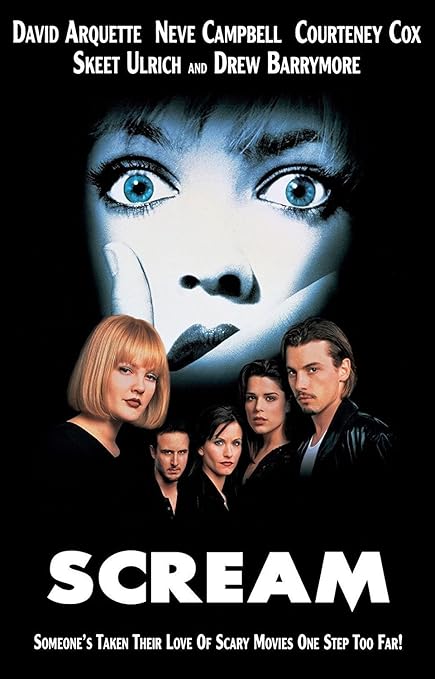
Unlike many representations of the final girl characters, Sidney is more knowledgeable and able, she does not get caught by the killer and unmasks the killer. The scream franchise is directly putting the female protagonist and female characters in danger and forcing the protagonist into the final girl role. A clear example of this at the beginning of the film, the character of Casey is left at home by herself and waiting for her parents to get home, she is preyed on by the killer because she is alone and vulnerable and ultimately killed. Again, this happens to the protagonist but the outcome is different than that of Casey’s. Sidney’s father leaves her alone in the house and she has a face off with the killer and she survives, Sidney also is the character to get revenge on the killer whom is her boyfriend, stripping away his masculinity. Sidney’s father, along with her boyfriend, are the murder suspects however, Sidney is left to save her father when he is captured by the killer, resulting him into being a damsel in distress character; which is usually reserved for the females in movies. As the female protagonist is left into saving her father, this ties into the idea that men are weaker than females in the modern slasher horror films.
To conclude the final girl trope in horror film is well known and used to exemplify strong female characters and how they overcome their femininity to defeat the killer.
References
Clover, C. (1992). Men, Women and Chainsaws: Gender in the Modern Horror Film. London: British Film Institute.
Karlyn, K. (2011). Unruly Girls, Unrepentant Mothers. Austin: Univ. of Texas Press, pp.99-103.
 leah's blog